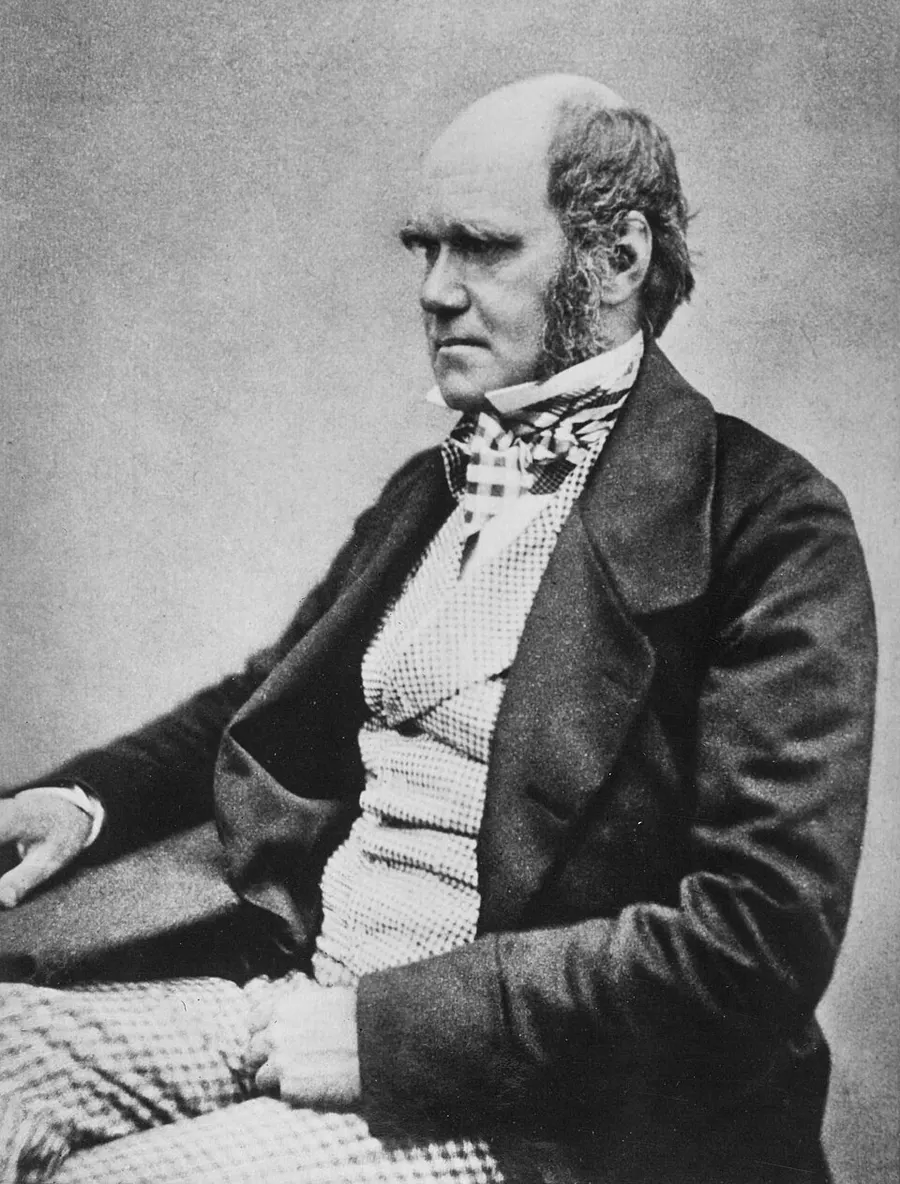
English Naturalist, Proposer of the Theory of Evolution
Those Who Changed How Humanity Thinks · Masters & Thinkers
EvolutionNatural SelectionThe Voyage of the Beagle
Who they are
Charles Darwin (1809–1882) was an English naturalist who in his youth made a five-year round-the-world scientific voyage aboard HMS Beagle, observing on the Galápagos Islands the subtle differences in finch beak shapes across different islands, planting the seed of the thought that "species are not fixed and unchanging." After more than twenty years of repeated verification and hesitation, he published On the Origin of Species in 1859, systematically setting out a theory of biological evolution with "natural selection" as its core mechanism, fundamentally challenging the then-prevalent Western belief that "species were created once by God and are fixed," and becoming one of the most important theoretical foundations of modern biology — while also stirring lasting religious and scientific dispute in his life and after.
Primary sourcesDarwin, On the Origin of SpeciesThe log of the voyage of the Beagle
Key stories
The Finches of the Galápagos
Charles Darwin · photograph, c. 1870s
On the Beagle voyage Darwin surveyed the Galápagos Islands and found that finch beak shapes differed subtly across islands according to the local food sources, an observation that became one of the key empirical clues in building his later theory of "natural selection"; the finches came to be called "Darwin’s finches."
A Theory He Long Feared to Publish
Darwin had formed the core of the theory of natural selection as early as the late 1830s, but fearing a strong religious and social backlash he shelved the manuscript for twenty years, until another naturalist, Wallace, independently proposed almost the same theory, the two published joint papers in the same year, and only then did Darwin hasten to publish On the Origin of Species.
Version differences
"Social Darwinism" (applying the theory of natural selection to social competition to justify colonialism or racism) was not Darwin’s own claim but a distorting appropriation of his theory by later thinkers — an important clarification in understanding the historical influence of Darwin’s thought.
Below are how modern works borrow or reinterpret this name or story — not the original material. The two differ, so keep them apart.
"Survival of the fittest" (an idiom)This phrase has fully entered everyday language, widely (and sometimes inaccurately) applied to all sorts of competitive settings, at a considerable distance from the rigorous scientific meaning of Darwin’s theory.