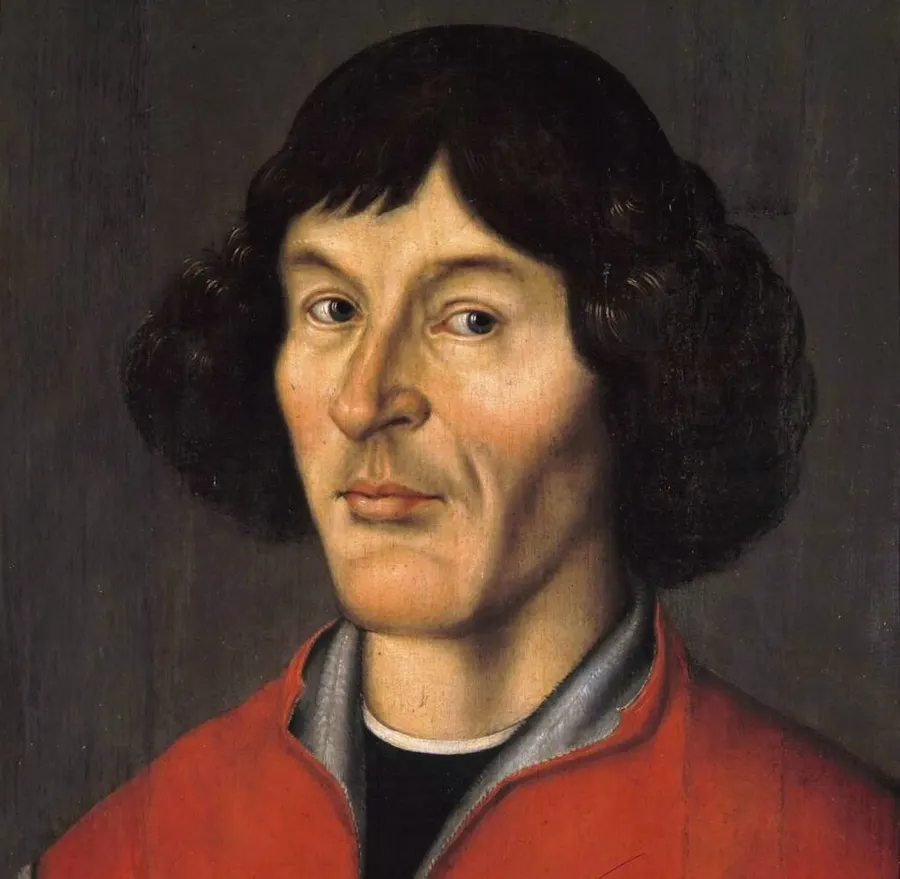
Nicolaus Copernicus (1473–1543) was a Renaissance Polish astronomer who systematically proposed the heliocentric model — "the sun at the center of the universe, with the earth and other planets orbiting it" — a theory that fundamentally challenged the geocentric system dominant since the ancient Greek Ptolemy. Knowing well the religious controversy it might stir, he long held back from publishing, and only in the last year of his life was his masterwork On the Revolutions of the Celestial Spheres formally published — legend says the printed copy reached his sickbed when he was already near death. This "Copernican revolution," further developed and confirmed by Galileo and Kepler, ultimately reshaped humanity’s whole framework for understanding the cosmos.
Primary sourcesCopernicus, On the Revolutions of the Celestial Spheres
Key stories
A Publication Delayed a Lifetime
Nicolaus Copernicus · Toruń portrait, 1580
Copernicus had formed the core of heliocentrism as early as the 1510s, but fearing strong opposition from church and scholars, he revised the manuscript again and again and long held back from formally publishing, until the last moments of his life in 1543, when On the Revolutions was finally printed — legend says the copy reached him when he was already delirious and near death, and he never truly witnessed the enormous response after his work appeared.
The "Copernican Revolution"
Copernicus’s heliocentrism was not only a correction of astronomical theory but a symbol of a fundamental shift in the human paradigm of knowledge — from the self-centered view of "humanity and Earth at the center of the universe" to acknowledging that Earth is but one of many bodies orbiting the sun. The phrase "Copernican revolution" was later widely borrowed for any major breakthrough that fundamentally overturns an existing framework of knowledge.
Below are how modern works borrow or reinterpret this name or story — not the original material. The two differ, so keep them apart.
"Copernican revolution" (an idiom)The phrase is widely borrowed in the history of science and even in everyday contexts for any major paradigm shift that fundamentally overturns an existing framework of knowledge — a concept even philosophers such as Kant borrowed.