Holy Roman Emperor and King of Spain, Forerunner of the "Empire on Which the Sun Never Set"
Those Who Drew the Lines on the Map · Founders & Monarchs
The Habsburg DynastyThe Holy Roman EmpireThe Spanish Empire
Who they are
Charles V (1500–1558) through complex Habsburg marriage inheritance held at once the titles of Holy Roman Emperor and King of Spain, ruling territories spanning Western and Central Europe and the colonies of the New World — a forerunner of the "empire on which the sun never set" (a phrase used then for territory so spread across time zones that "the sun never sets"). His reign coincided with Martin Luther’s Reformation, and Charles, as defender of Catholicism, repeatedly tried to suppress Protestant forces yet could never stop their spread among the German states; worn out in his later years, he abdicated of his own accord in 1556, dividing his vast lands between his brother and son and retiring to a monastery until his death.
Primary sourcesHoly Roman Empire court archivesRecords of the Diet of Worms
Key stories
Confronting Luther at the Diet of Worms
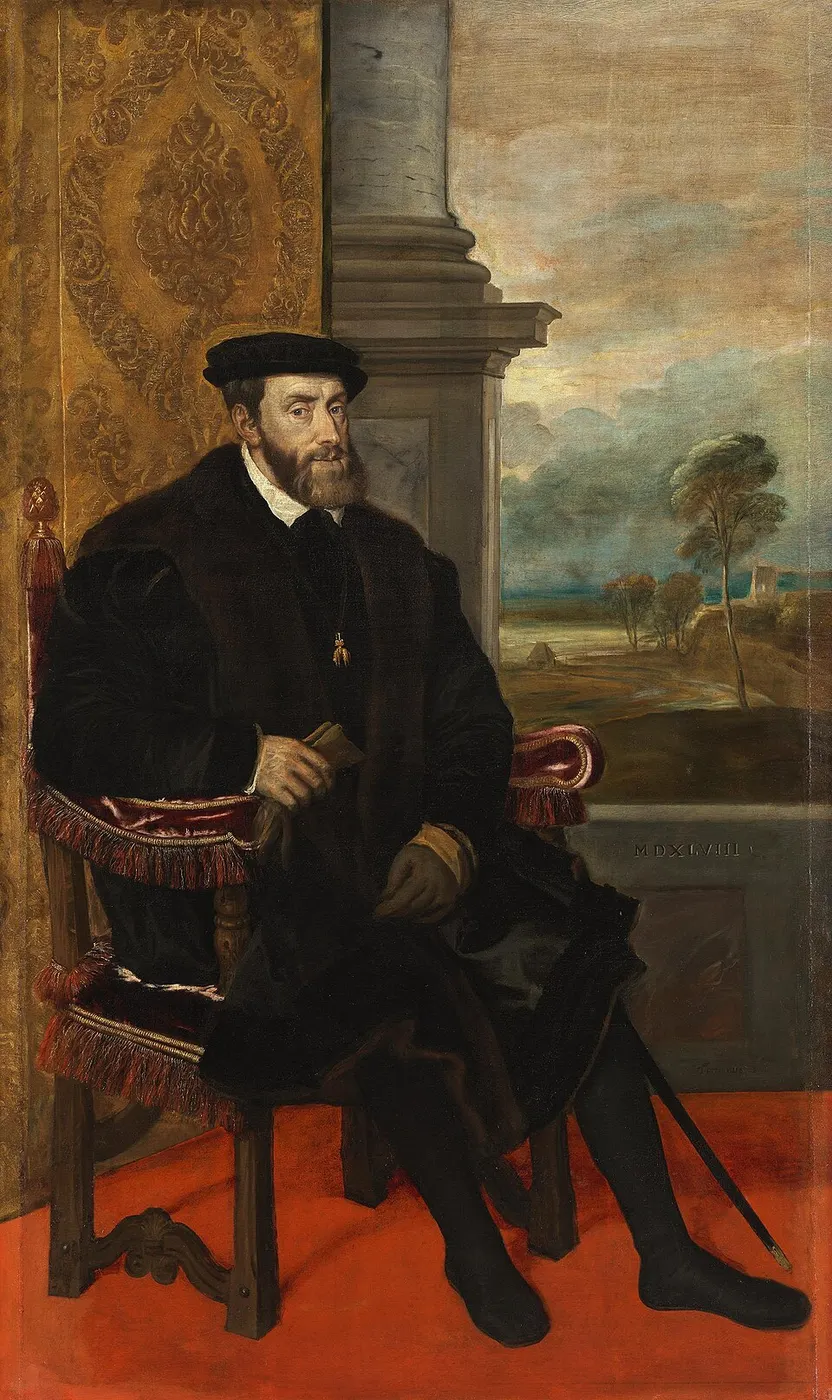
Charles V seated · formerly attr. Titian, Alte Pinakothek
In 1521 Charles V convened the Imperial Diet at Worms and summoned Martin Luther to recant the views in his works; Luther refused before all, leaving the famous line "here I stand; I can do no other." Charles then declared Luther a heretic outside the law’s protection, but because the German princes had their own designs, the edict was never effectively enforced, and the Reformation spread on.
Voluntary Abdication
After nearly forty years’ rule, Charles V, spent in body and mind, made the rare decision in 1556 to abdicate of his own accord, passing Spain and the American colonies to his son Philip II and the Holy Roman imperial throne to his brother Ferdinand I, and retiring to a monastery in Spain until his death — a voluntary surrender of supreme power extremely rare among European monarchs.
Below are how modern works borrow or reinterpret this name or story — not the original material. The two differ, so keep them apart.
"The empire on which the sun never set" (an idiom)The phrase was first used precisely to describe Charles V’s domain spanning Europe and the Americas, on which, across the time zones, "the sun never set," and was later widely borrowed for other vast colonial empires such as the British Empire.