One Story Remembered for Life · Small Roles, Famous Names
The Holy Roman EmpireThe East Frankish KingdomChurch–State Relations
Who they are
Otto I (912–973) was king of East Francia who, through a run of military victories (above all his defeat of the invading Magyars at the Battle of Lechfeld), consolidated his ruling authority, and in 962 was crowned emperor in Rome by Pope John XII — a title generally taken as the formal beginning of the political entity known as the "Holy Roman Empire," which in name carried on the political imagination of Charlemagne’s empire as "Roman emperor" and endured for nearly nine hundred years until Napoleon formally abolished it in 1806. Otto I’s coronation also once again set the basic pattern, running through later European history, of church power and imperial power at once depending on and repeatedly contending with each other.
Primary sourcesWidukind, Deeds of the SaxonsEarly Holy Roman Empire documents
Key stories
The Battle of Lechfeld
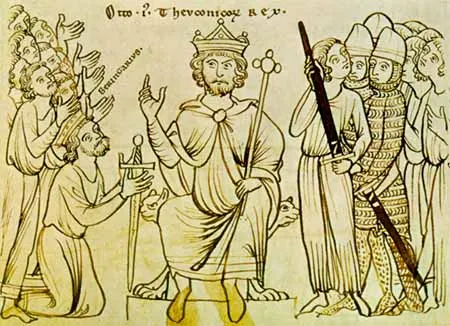
Otto I in a medieval manuscript · manuscript, c. 1200
In 955 Otto I led the East Frankish army to a crushing defeat of the Magyars, a nomadic people who had long harried Central Europe, at Lechfeld — a decisive victory that ended the Magyars’ threat of large-scale raids on Western Europe and greatly raised Otto’s prestige among the various princes of his realm, clearing the road to his later imperial coronation.
The Coronation in Rome
In 962 Otto I, at the request of Pope John XII, sent troops into Italy to quell disorder, and was then crowned "Emperor of the Romans" in Rome — a title echoing Charlemagne’s coronation of old, and marking the formal entry onto the stage of history of the "Holy Roman Empire," a political entity that would endure for nearly nine hundred years.
Below are how modern works borrow or reinterpret this name or story — not the original material. The two differ, so keep them apart.
The "Ottonian Renaissance" (a scholarly term)In art history the "Ottonian Renaissance" denotes a wave of revival in manuscript painting and architecture under court patronage during his reign — an important research topic in medieval art history.