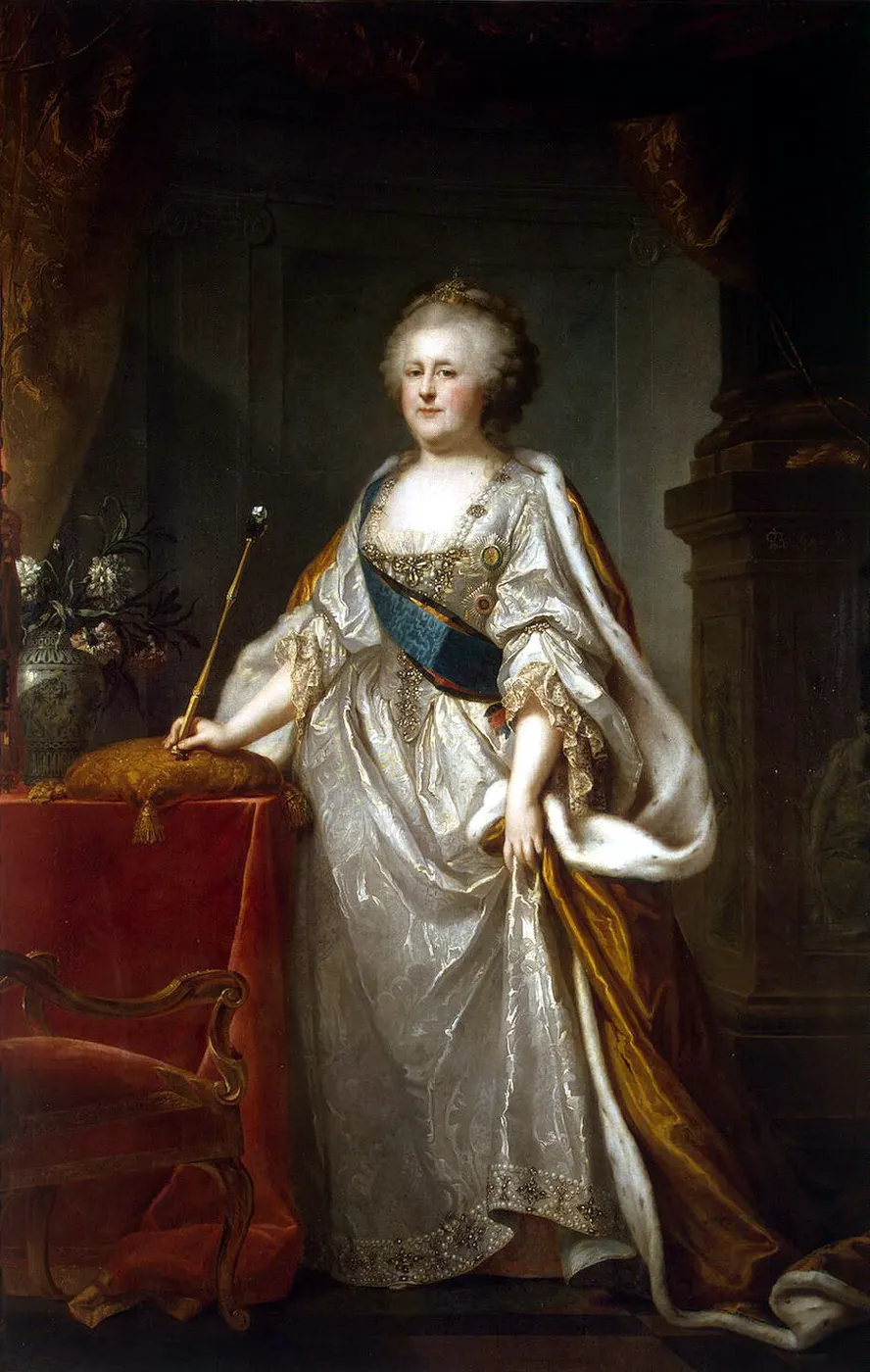
Empress of Russia, a Representative of Enlightened Absolutism
Those Who Drew the Lines on the Map · Founders & Monarchs
The Russian EmpireEnlightened AbsolutismThe Russo-Turkish Wars
Who they are
Catherine II (1729–1796) was originally a princess of a small German state who, married into the Russian imperial house, took the throne by a palace coup overthrowing her husband Peter III, and in a 34-year reign vastly expanded Russia’s borders, winning an outlet to the Black Sea through repeated Russo-Turkish wars and joining in the partitions of Poland, while corresponding with Enlightenment thinkers like Voltaire and patronizing art and education — a representative of the "enlightened absolutist" monarch. Yet under her the condition of serfdom in fact worsened, a contradiction often raised in assessing her "enlightened" image.
Primary sourcesCatherine II’s autobiographical memoirsHer collected correspondence with Voltaire
Key stories
Seizing the Throne by Coup
Catherine II · J. B. Lampi, 1794, the Hermitage
When Catherine’s husband Peter III, unpopular on taking the throne, was deposed in 1762 by a coup Catherine led with guards officers (Peter III soon died in strange circumstances, widely thought connected to the coup faction though the details are doubtful), she took the throne herself and began a reign of over thirty years.
The Correspondence With Voltaire
Catherine long corresponded with the French Enlightenment thinker Voltaire, styling herself a practitioner of "enlightened absolutism," funding the publication of the Encyclopedists and buying up much European art for the court (collections that later formed an important basis of the Hermitage in St. Petersburg) — yet under her the bonds of Russian serfdom not only did not loosen but tightened further, a contradiction later historians often note.
Version differences
Her correspondence with Enlightenment thinkers such as Voltaire is often read as proof of "enlightened absolutism," but scholars also note it was largely a carefully cultivated public image, and that the actual condition of serfdom under her rule did not improve thereby but worsened further.
Below are how modern works borrow or reinterpret this name or story — not the original material. The two differ, so keep them apart.
The Hermitage MuseumThe great body of European art she acquired forms an important foundation of the collection of the Hermitage Museum in St. Petersburg, now one of the largest art museums in the world.