Piazza Navona
📍 Old TownAn oblong piazza whose very shape is the racetrack of the ancient stadium beneath it; at its center, Bernini’s Fountain of the Four Rivers.
- 🦅 Empire
Empire · The Stadium of Domitian
The piazza’s odd oblong is the exact outline of the racetrack of Domitian’s 1st-century stadium.
Why is Piazza Navona this long shape rounded at both ends? Because it sits directly on the stadium Emperor Domitian built in 86 AD, where ancient Romans watched athletic contests. In the Middle Ages people built houses straight onto the foundations of the stands, "freezing" the whole stadium’s outline into the fabric of the city. To stroll the piazza today is to walk on a racetrack nineteen centuries old.
Sources:Remains of the ancient Stadium of Domitian · Studies of the urban form of Piazza Navona
- 🎨 Arts
↑ Because of the last layer:Precisely because the ancient stadium left a ready-made grand open space, Baroque Rome chose it as its most splendid urban drawing room.
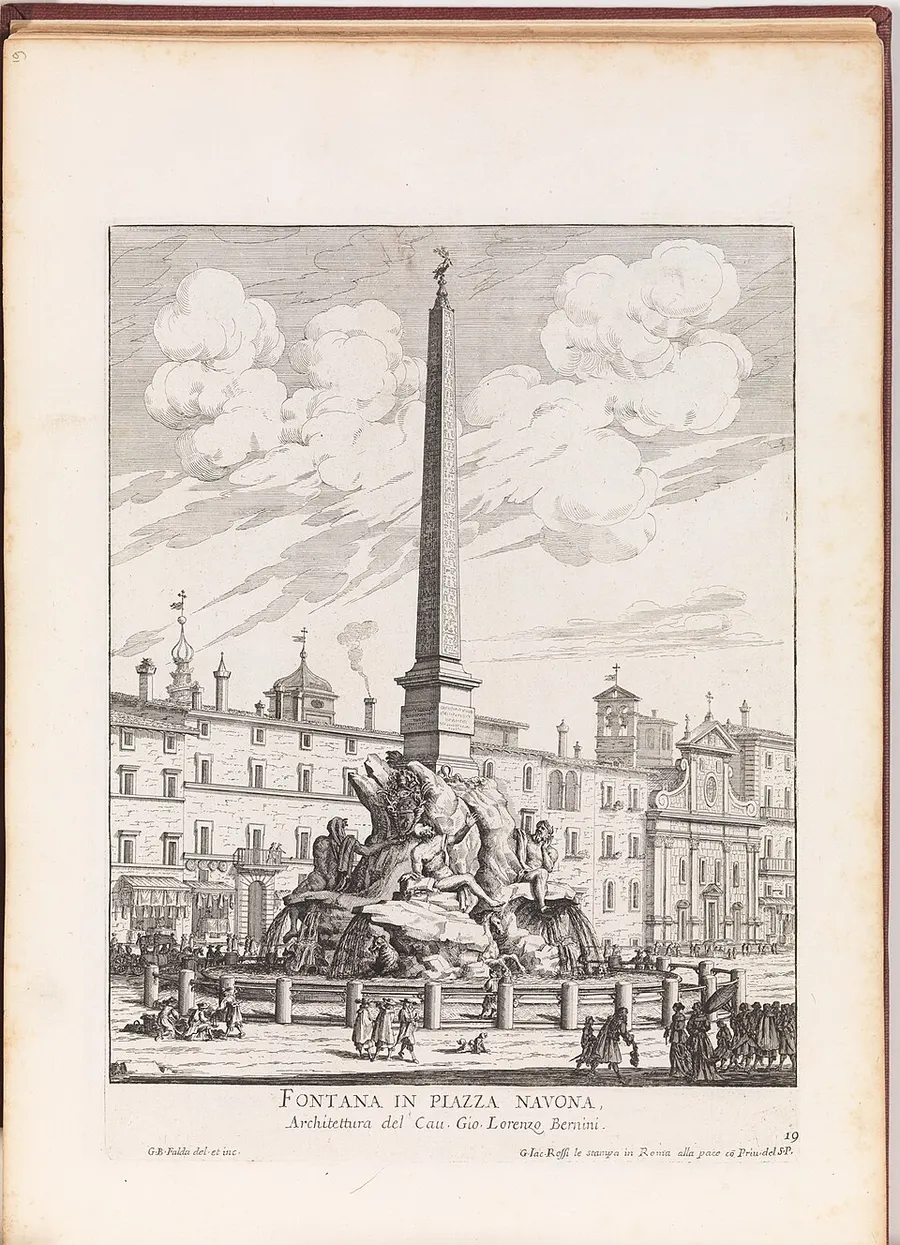
Arts · Bernini’s Fountain of the Four Rivers
At the center stands Bernini’s Baroque masterpiece, four river-gods for the four known continents.
The Fountain of the Four Rivers at the center is a signature work of the king of the Baroque, Bernini: four giants embody the Nile, the Ganges, the Danube, and the Río de la Plata — Africa, Asia, Europe, and the Americas. One fountain holds the whole world Europeans then knew. Legend says Bernini deliberately had the river-god facing the opposite church raise a hand to shield his face, mocking his rival Borromini, that church’s architect (a much-told tale of doubtful truth).
Sources:Fountain of the Four Rivers (1651) · Baroque art history after the Vasarian tradition
🔭 Meanwhile in the world
In Rome:Bernini’s Fountain of the Four Rivers is completed in Piazza Navona.
At the same time, elsewhere:At the same time, the Qing had just taken China, Newton was about to be born, and the Scientific Revolution was rising.
Free email course
Rome in 7 Lessons
Before you go, load the stories behind every stone. Seven emails, Colosseum to Sistine — so on the ground you see more than ruins.
That email didn’t look right — try again?
Free · unsubscribe anytime · Privacy