King of Baroque sculpture and architecture, the man who "made marble breathe"
Putting the Human Back at the Center · Renaissance & Baroque
BaroqueSculptureArchitectureRome
Who they are
The embodiment of Baroque art, who single-handedly shaped the face of the Rome we see today. Sculptor, architect, painter, and stage designer at once, of dazzling gift and astonishing energy, he served nearly the whole of seventeenth-century Rome. He could make hard marble look soft as flesh, flowing as cloth, even seem to breathe — the swoon of one struck by divine love in The Ecstasy of St Teresa, the instant in Apollo and Daphne where the girl’s fingertips are turning into laurel leaves, all frozen in stone. He designed the vast oval colonnade embracing the piazza of St Peter’s and the bronze baldachin within, and for Rome made the Fountain of the Four Rivers in the Piazza Navona — if Michelangelo defined Renaissance Rome, Bernini defined Baroque Rome.
Primary sourcesThe Ecstasy of St Teresa, Apollo and Daphnethe colonnade and bronze baldachin of St Peter'sthe Fountain of the Four Rivers, Piazza Navona
Key stories
Making Marble Flow and Breathe
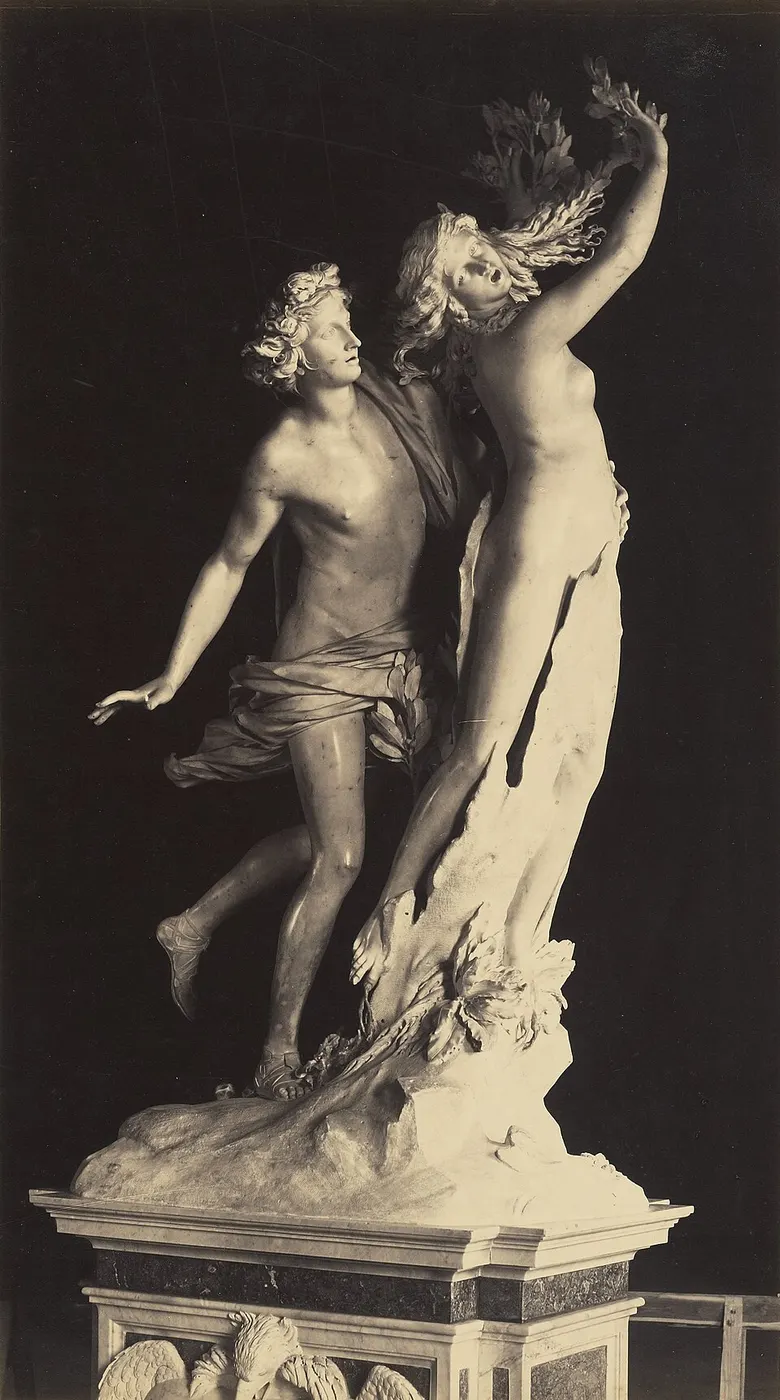
Apollo and Daphne · Bernini, Galleria Borghese; 19th-century photograph
Bernini’s most astonishing gift was to give the hardest, coldest material the softest, most living texture. In Apollo and Daphne he seized the very instant when the fleeing Daphne’s fingers and hair-ends are turning into laurel branches, making the marble seem to grow; in The Ecstasy of St Teresa the saint’s robes surge like water and her face is rapt with divine love. Viewers often forget they are looking at mere stone — which is exactly what the Baroque sought: to move by emotion and deceive by illusion.
A Piazza That Embraces the World with Two Arms
The piazza Bernini designed for St Peter’s is a pair of huge oval colonnades reaching forward, like the Church opening its arms to embrace the flocking faithful. He explained it himself: these two colonnades are "maternal arms." A sculptor conceived a whole piazza as one gigantic sculpture, giving the very space of the city emotion and gesture — the summit of the Baroque fusion of architecture, sculpture, and drama.
Below are how modern works borrow or reinterpret this name or story — not the original material. The two differ, so keep them apart.
Defined "Baroque Rome"Bernini's fountains, piazzas, and sculptures are still central to the face of Rome; the oval colonnade of St Peter's Square and the Fountain of the Four Rivers in Piazza Navona are must-see stops for visitors worldwide, and 'making marble breathe' became a common praise for sculptural realism.