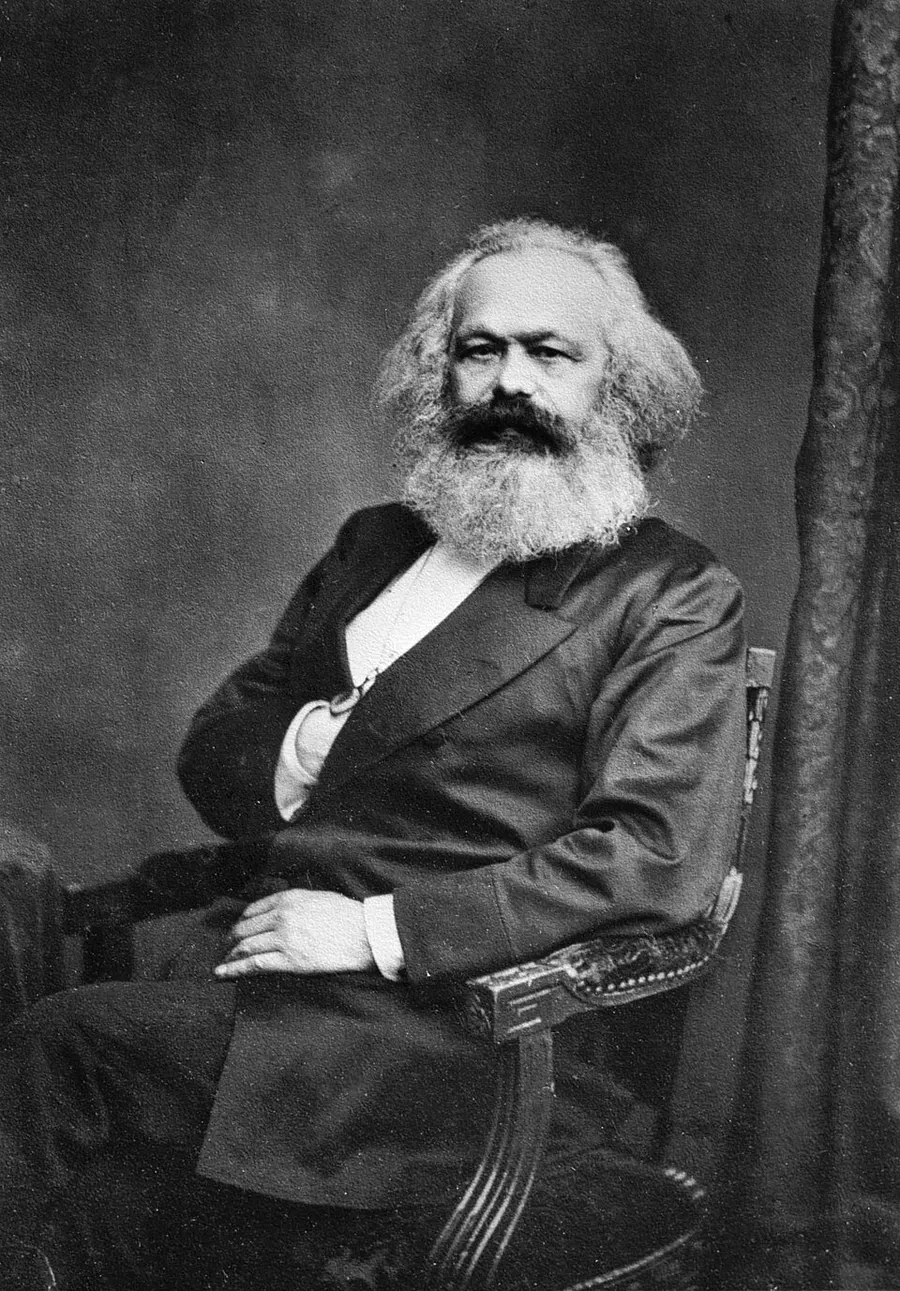
German Philosopher, Proposer of Historical Materialism
The First to Ask the Right Question · Founders
Historical MaterialismThe Theory of AlienationDialectical Materialism
Who they are
Karl Marx (1818–1883) was a German philosopher and political economist who "turned over" Hegel’s dialectic from its idealist framework and proposed "historical materialism": it is not abstract ideas that drive history forward, but the contradictory movement of the material mode of production that determines the succession of social forms — "it is not the consciousness of men that determines their being, but their social being that determines their consciousness." The theory of "alienation" he proposed in his early works analyzes the phenomenon whereby, under the capitalist mode of production, the worker is estranged and alienated from his own labor product, from the process of labor, from his species-being, and even from others; this analytical framework was later widely applied to the critique of society and culture beyond the scope of economics, and is an important source of twentieth-century Western Marxism, the Frankfurt School, and other schools of thought.
Primary sourcesMarx and Engels, The Communist ManifestoMarx, Theses on FeuerbachMarx, Das Kapital
Key stories
"The Philosophers Have Only Interpreted the World; the Point Is to Change It"
Karl Marx · photograph by John Mayall, 1875
Marx proposed this famous statement in the eleventh of his Theses on Feuerbach, written in his youth, marking his fundamental break with the earlier philosophical tradition content with pure speculation to interpret the world, and his turn to stressing that philosophy should serve the practical action of transforming real society; the line was later carved at the top of his tombstone in Highgate Cemetery, London.
Das Kapital in the British Museum
During his London exile Marx went almost daily to the round Reading Room of the British Museum to research and write, and the first volume of Das Kapital was published in 1867 only after nearly twenty years of repeated revision; through a double philosophical and economic dissection of the operating logic of the capitalist economy, he sought to reveal its inner contradictions and historical limits.
Version differences
The regimes set up in various countries in the twentieth century in the name of "Marxism" differed greatly in their concrete practical paths, and scholars broadly hold that these practices involved considerable reinterpretation of and departure from Marx’s own philosophical texts.
Below are how modern works borrow or reinterpret this name or story — not the original material. The two differ, so keep them apart.
"The philosophers have only interpreted the world; the point is to change it"This maxim carved on his tombstone in Highgate Cemetery, London, is still among the most frequently quoted philosophical statements in discussing "the relationship of theory and practice."