The record of Laozi’s life is itself full of uncertainty — Sima Qian’s Records of the Grand Historian gives several coexisting accounts of his identity, and scholars have long debated the date of composition and authorship of the Dao De Jing. Tradition holds that he served as keeper of the archives of the Zhou court, and, seeing the decline of the Zhou house, went west into seclusion, leaving at the Hangu Pass, at the request of the pass warden Yin Xi, the five thousand words of the Dao De Jing. This work takes "Dao" as its core concept, advocating "the Dao follows what is natural" and "governing by non-action" (wu wei), holding that excessive human interference often works against itself; the dialectical wisdom that "the soft and weak overcome the hard and strong" runs through the whole book. It is the founding text of Daoist thought and profoundly shaped China’s political philosophy, military thought, and even its tradition of artistic aesthetics.
Primary sourcesThe Dao De Jing
Key stories
Leaving West Through the Hangu Pass
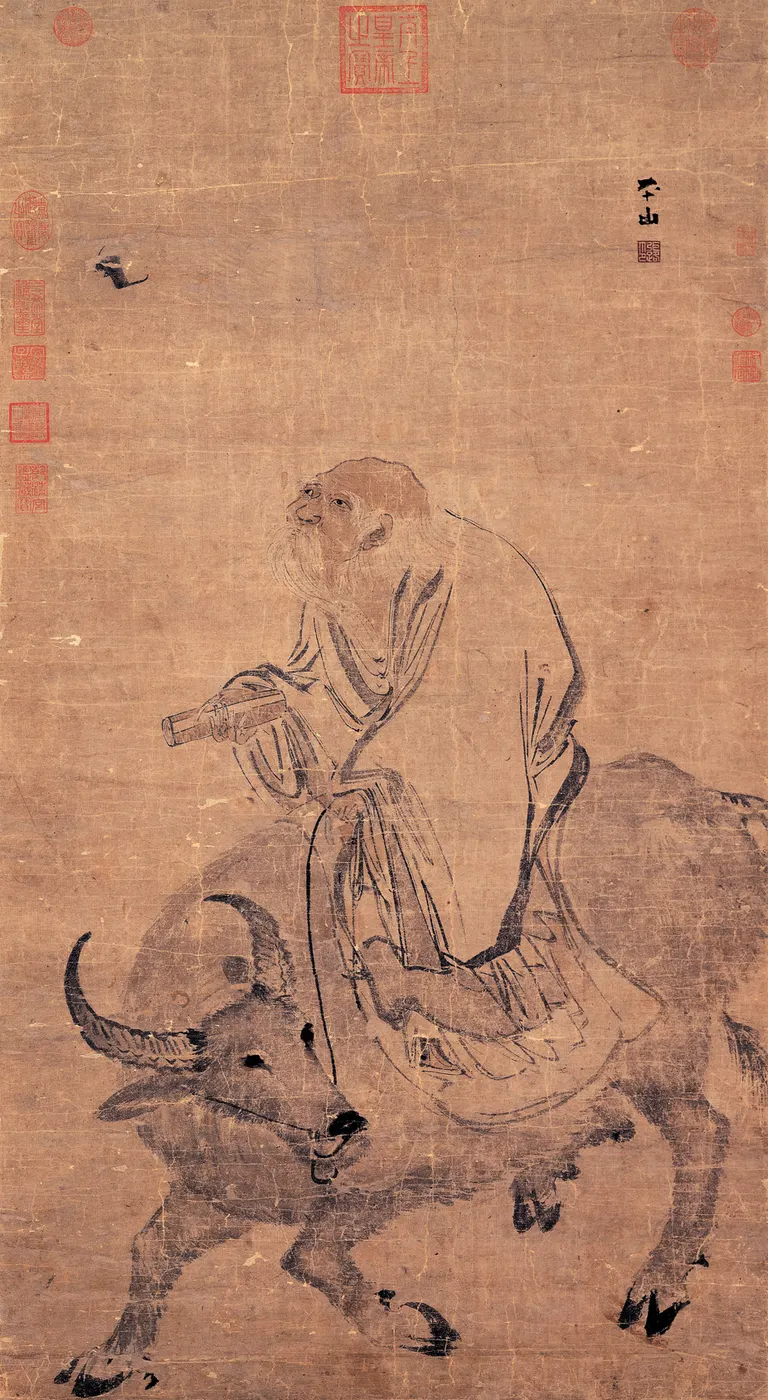
Laozi Riding an Ox · Zhang Lu, Ming dynasty
Legend says that Laozi, seeing the Zhou house in decline and the realm about to fall into chaos, rode a black ox west into seclusion, and, reaching the Hangu Pass, the pass warden Yin Xi, seeing a purple vapor coming from the east and judging that an extraordinary man was passing, earnestly asked him to leave a writing. Laozi then wrote the five thousand words, in two parts, the "Dao" classic and the "De" classic, and thereafter drifted away, no one knowing where he ended.
"The Highest Good Is Like Water"
The Dao De Jing expounds its core wisdom of living with the line "the highest good is like water; water benefits all things and does not contend." Water nourishes all things yet never contends with them for height, and instead willingly dwells in the low places that people disdain; this "non-contending," yielding posture holds precisely the dialectical power of "overcoming the hard with the soft" — the most vivid metaphor for the Daoist thought of "non-action."
Version differences
Laozi’s historical reality is debated among scholars; Sima Qian’s Records of the Grand Historian itself gives several coexisting accounts of his identity, and the date of composition of the Dao De Jing has long been debated too.
Below are how modern works borrow or reinterpret this name or story — not the original material. The two differ, so keep them apart.
"The highest good is like water" (an idiom)Still a common idiom for the wisdom of humble, accommodating conduct, derived directly from the Dao De Jing.
The taiji diagram (yin-yang fish)The iconic Daoist symbol, appearing widely in modern design, martial arts, and popular culture, symbolizing the cosmology of yin and yang generating and complementing each other.