🦉Thought & FaithPhilosophy
🏠 Home🌐 中文
PhilosophyAGORA
🔍

Descartes

Original nameRené Descartes

French Philosopher and Mathematician, Proposer of "I Think, Therefore I Am," Father of Modern Philosophy

The First to Ask the Right Question · Founders
RationalismMind–Body DualismMethodological Doubt

Who they are

René Descartes (1596–1650) was a French philosopher and mathematician, acknowledged as the "father of modern philosophy." He proposed the method of "universal doubt": setting aside for the time being every belief that could possibly be doubted, in the attempt to find an unshakable ground of certainty, and at last derived "I think, therefore I am" (Cogito, ergo sum) — for even in doubting everything, the very fact that "I am doubting, am thinking" cannot be doubted, and this became the first cornerstone on which he rebuilt the whole edifice of knowledge. He also proposed "mind–body dualism," holding that the mind (a thinking substance) and the body (an extended substance) are two substances of utterly different natures — a stance that long dominated Western philosophy’s discussion of "how mind and body interact," and the source of the "Cartesian dualism" still repeatedly examined and criticized today.

Primary sourcesDescartes, Meditations on First Philosophy, Discourse on the Method

Key stories

The Fireside Meditation of "I Think, Therefore I Am"
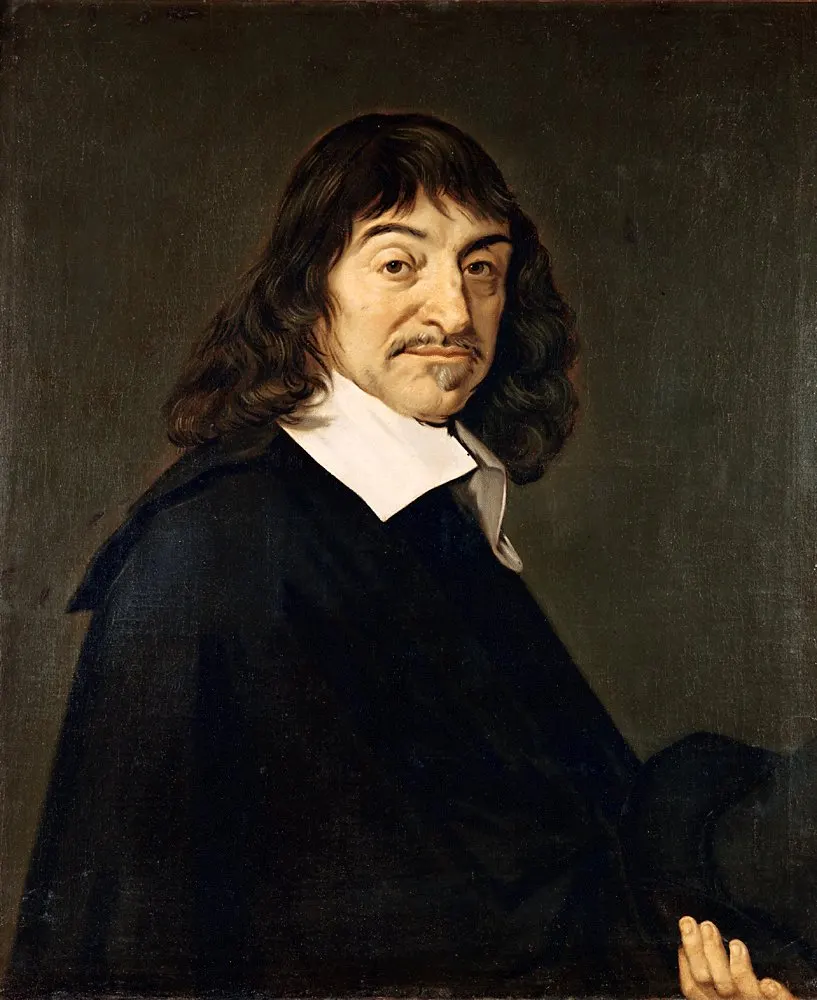
René Descartes
René Descartes · after Frans Hals, c. 1649

Legend says Descartes once sat alone in a room by the fire on a cold winter’s day in long philosophical meditation, doubting one by one his sensory experience, mathematical truths, and even the existence of the external world, and at last found that only the fact that "I am doubting, am thinking" could not itself be doubted — for doubt is itself proof of the activity of thinking. This thought experiment was later distilled into "I think, therefore I am," the most famous proposition in the history of Western philosophy.

The Invention of Analytic Geometry

Descartes was at the same time an outstanding mathematician, who brought algebraic methods into geometry and founded "analytic geometry," using a coordinate system to turn geometric figures into algebraic equations for handling — a method that later became an important foundation for the development of calculus, and the "Cartesian coordinate system" is still basic content in secondary-school mathematics education worldwide.

Relationships

Echoes today

Below are how modern works borrow or reinterpret this name or story — not the original material. The two differ, so keep them apart.

"I think, therefore I am" (a common quotation)This Latin proposition (Cogito, ergo sum) is the most frequently quoted single proposition in the history of Western philosophy, appearing widely in popular culture, advertising, and even science fiction.
The Cartesian coordinate systemThe analytic-geometry coordinate system he invented is still basic content in secondary-school mathematics education worldwide.

Appears in

Curiosity mailCurious about world civilization? Leave your email — we’ll tell you when there’s something worth a look.

Free · unsubscribe anytime · Privacy