🦉Thought & FaithPhilosophy
🏠 Home🌐 中文
PhilosophyAGORA
📖

Confucius

Thinker of the Spring and Autumn Period, Founder of Confucianism

The First to Ask the Right Question · Founders
ConfucianismRen and LiThe Analects

Who they are

Confucius (551–479 BC) was a thinker of the state of Lu in the late Spring and Autumn period and the founder of Confucianism, who traveled among the states for fourteen years preaching his political ideals of "restraining the self and returning to ritual" and "governing by virtue." Though he never in his life won a single ruler’s true adoption of his approach to statecraft, in education he had followers throughout the land — three thousand disciples by tradition, seventy-two of them worthies — and his educational principle of "teaching without distinction of class" broke the earlier aristocratic monopoly on education. His core idea of "ren" (benevolence) stresses the moral awareness of extending oneself to others, and "li" (ritual) stresses the norms and restraints of social order, the two complementing each other to form the intellectual cornerstone of East Asian social ethics and political order for the two thousand years after; his words and deeds were compiled by his disciples into the Analects.

Primary sourcesThe Analects

Key stories

Fourteen Years Traveling Among the States
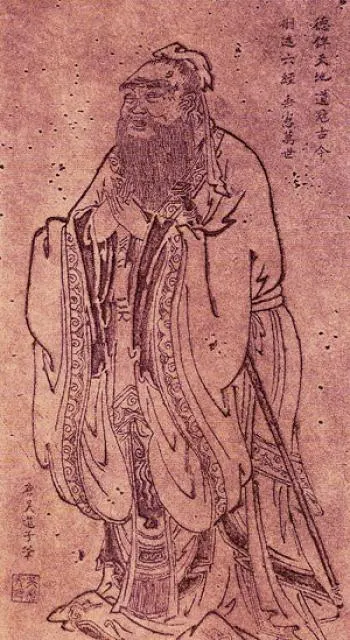
Confucius
Confucius · Tang-dynasty portrait

In middle age Confucius held for a time a high post in Lu to put his political ideals into practice, but lost the office to defeat in political struggle, and thereafter led his disciples traveling among the states of Wei, Chen, Cai, Chu, and others for fourteen years, preaching his ideas of statecraft everywhere, yet meeting rebuff after rebuff — once even stranded and out of provisions between Chen and Cai, nearly starving — and only in old age returned to Lu to devote himself to teaching, writing, and editing the classics.

"Do Not Do to Others What You Would Not Have Done to Yourself"

When the disciple Zigong asked Confucius whether there was one word to be practiced for a whole life, Confucius answered, "Is it not reciprocity? Do not do to others what you would not have done to yourself." This line is seen as the most concentrated practical statement of the core Confucian concept of "ren," often discussed alongside the "Golden Rule" of Western ethics, and is the most universal moral precept in Confucian thought.

Relationships

Echoes today

Below are how modern works borrow or reinterpret this name or story — not the original material. The two differ, so keep them apart.

"Do not do to others what you would not have done to yourself" (an idiom)Seen by scholars as the core statement of the Confucian idea of "reciprocity," often discussed alongside the Western "Golden Rule."
The Confucius InstitutesThe language and culture promotion institutions China has established worldwide, named for Confucius, a modern extension of his role as a symbol of Chinese culture abroad.

Appears in

Curiosity mailCurious about world civilization? Leave your email — we’ll tell you when there’s something worth a look.

Free · unsubscribe anytime · Privacy