One of the Most Influential Philosophers and Theologians of Early Christianity
Those Who Ground an Idea Into a Whole System · Disciples & School-Builders
Christian PhilosophyThe Theory of TimeOriginal Sin and Grace
Who they are
Augustine (354–430) was born in North Africa, and in his early years indulged in pleasure, his thought wandering between Manichaeism and Neoplatonism; after converting to Christianity he became bishop of Hippo, and his philosophical-theological works the Confessions and The City of God profoundly shaped the course of Western Christian philosophy for the thousand years after. As a philosopher, in Book XI of the Confessions he raised a most penetrating inquiry into the nature of "time": "What then is time? If no one asks me, I know; if I wish to explain it to one who asks, I know not." He proposed that time is not an objective reality independent of the mind, but the mind’s measurement of the threefold conscious activity of "memory of the past, attention to the present, expectation of the future" — this theory of the "mental interiority of time" came more than thirteen hundred years before Kant’s transcendental view of time, one of the most profound early inquiries into the nature of time in the history of philosophy.
Primary sourcesAugustine, Confessions, The City of God
Key stories
The Conversion in the Garden
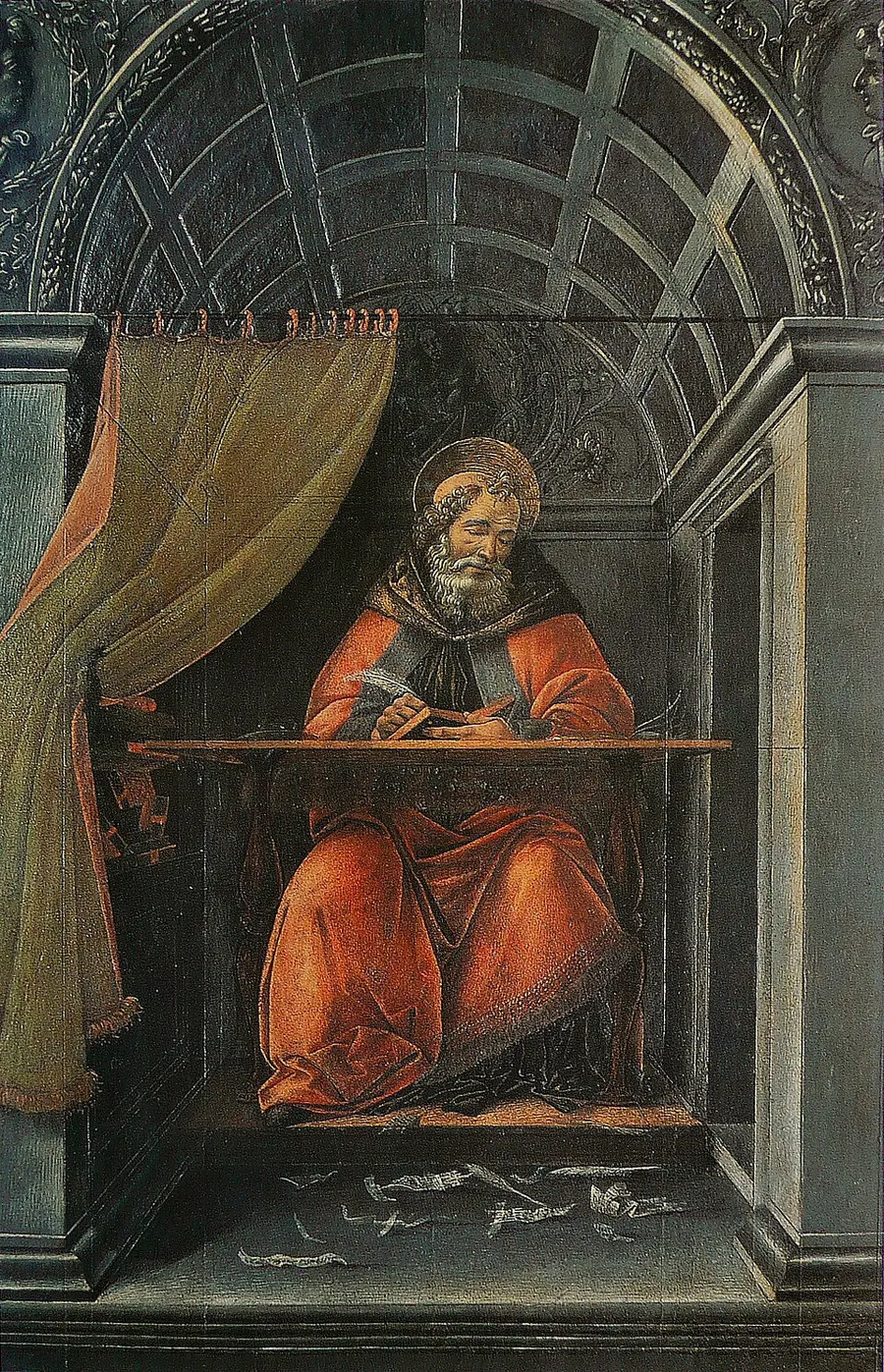
St Augustine in His Study · Botticelli, c. 1480
In the Confessions Augustine records that, wrestling in anguish in a garden in Milan, he heard the singing of a neighbor’s child repeating "take up and read, take up and read," and, opening the Bible at hand, his eyes fell on a passage about casting off dissipation and putting on Christ, and from that moment the struggle within was suddenly resolved and he decided to be baptized and believe in Christianity.
The Philosophical Inquiry "What Is Time?"
In the Confessions Augustine proposed that the past no longer exists and the future has not yet come, and only the "present" truly exists, yet the "present" is itself a ceaselessly passing, ungraspable instant — from which he argued that what we call "past," "present," and "future" are in fact three present activities of the mind (memory, direct perception, expectation), and that the reality of time depends in essence on the conscious activity of the mind, not on an objective container independent of the mind.
Below are how modern works borrow or reinterpret this name or story — not the original material. The two differ, so keep them apart.
The autobiographical genre of the ConfessionsWidely regarded as one of the earliest works of the autobiographical genre in the history of Western literature, its "inner monologue" manner of writing influenced a great body of later autobiographical literature.