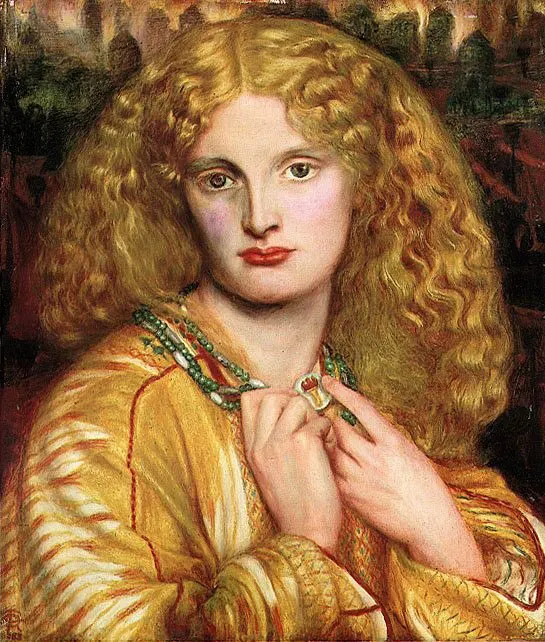
Daughter of Zeus and Leda, born from a swan’s egg, the most beautiful woman alive. As a girl she was once carried off by Theseus; at her marriage all the suitors of Greece swore to defend her union — an oath that later conscripted the entire nation. Marlowe’s famous line asks of her: "Was this the face that launched a thousand ships?"
Primary sourcesHomer, Iliad
Key stories
The Oath of the Suitors
Helen of Troy · Rossetti, 1863, Hamburger Kunsthalle
Every king in Greece came to court her, and the situation was a tinderbox. Odysseus advised: have every suitor swear that whoever is chosen, the rest will defend the marriage. Helen chose Menelaus. Years later she ran off with Paris, the oath was triggered, and a thousand ships sailed — the widest-reaching guarantee ever signed.
The Night the City Fell
When Troy fell, Menelaus rushed at his faithless wife with drawn sword. Helen turned to face him, and the blade dropped to the ground. In Homer she sits in old age in the palace of Sparta, calmly telling guests of the days of Troy as if it were someone else’s story — so beautiful even a reckoning was waived.
Version differences
In his tragedy Helen, Euripides gives a completely different ending: the real Helen was secretly spirited off to Egypt by the gods, and what was fought over at Troy for ten years was only a phantom of cloud made by the queen of heaven. This version never supplanted the mainstream Homeric account, but it shows that "whether Helen was really at Troy" had no single answer even in antiquity.