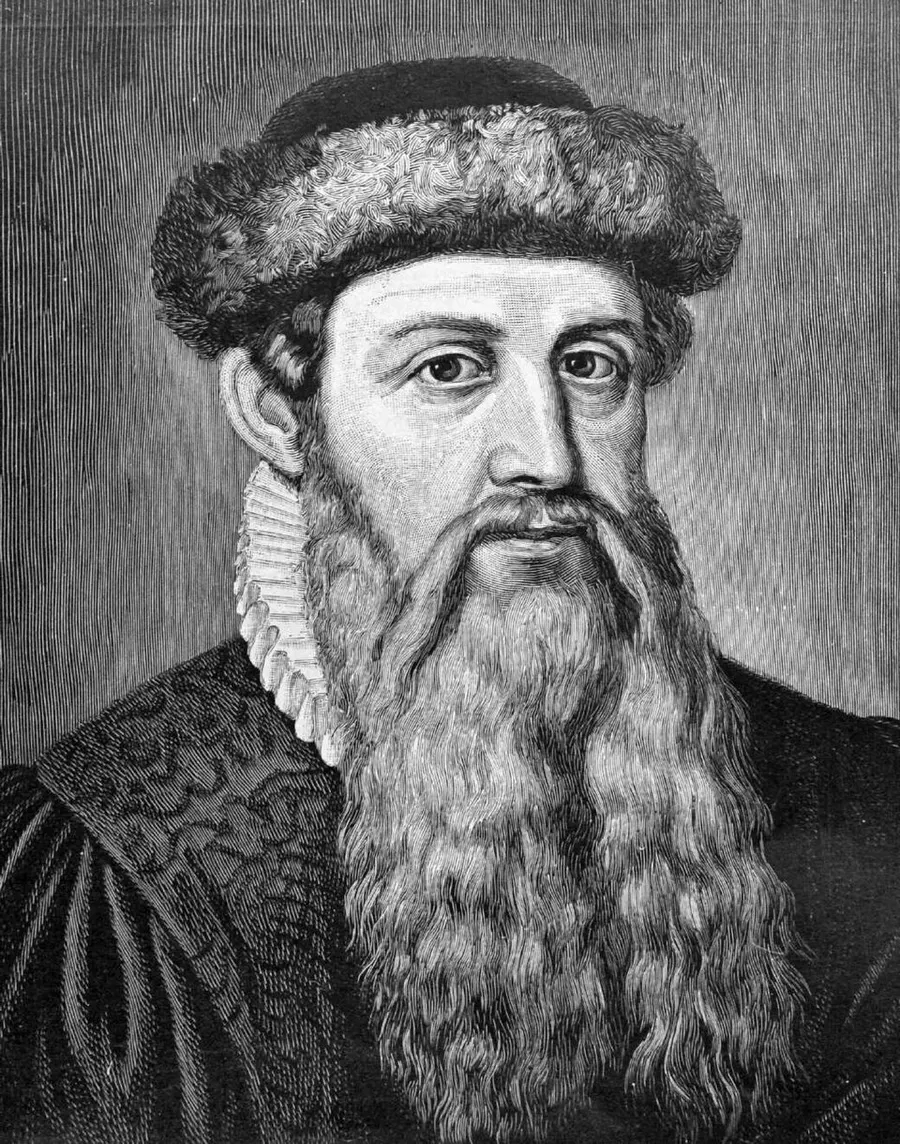
German Craftsman, the European Popularizer of Movable-Type Printing
One Story Remembered for Life · Small Roles, Famous Names
Movable-Type PrintingThe Printing RevolutionThe Spread of Knowledge
Who they are
Johannes Gutenberg (c. 1400–1468) was a goldsmith and craftsman of Mainz in Germany who developed a metal movable-type printing technology suited to the European alphabet, together with the matching printing press; the Gutenberg Bible printed in the 1450s was the first book produced on a large scale in Europe. The technology then spread fast across Europe, sharply lowering the cost of copying books and multiplying the efficiency of their production, profoundly accelerating the spread of Reformation ideas, scientific knowledge, and literary works — Martin Luther’s Ninety-Five Theses were exactly what the printing press let spread swiftly across the German lands. Gutenberg’s technical improvement was not itself the earliest invention of movable type (movable-type printing had appeared earlier in East Asia), but his achievement enormously advanced the technology’s spread and far-reaching social impact in Europe.
Primary sourcesSurviving copies of the Gutenberg BibleMainz municipal archives
Key stories
The Gutenberg Bible
Johannes Gutenberg · 16th-century engraving
Gutenberg spent years of labor preparing his printing equipment and capital, and at last printed some 180 copies of the Gutenberg Bible, every page striving for a neat layout and beautiful type, aiming to match the artistic standard of the handwritten Bibles of the day. Only some forty copies of this Bible survive today (some incomplete), rare treasures that libraries and museums the world over vie to hold.
One Technology That Changed an Age
Within a mere half-century of the spread of Gutenberg’s printing, the total number of books printed in Europe surpassed the whole accumulation of handwritten copies over the preceding thousand-odd years, and the speed and reach of the spread of knowledge and ideas thereby took a fundamental leap — a technical innovation that played an irreplaceable part in accelerating the spread of the Reformation, the Renaissance, and the Scientific Revolution.
Below are how modern works borrow or reinterpret this name or story — not the original material. The two differ, so keep them apart.
The "person of the millennium" pollsWhen several Western media outlets at the millennium chose "the most influential person of the past thousand years," Gutenberg, for the far-reaching influence of printing, ranked at the top year after year.