Castel Sant'Angelo
📍 Tiber RiversideFour lives of one building: emperor’s tomb → fortress → prison → museum.
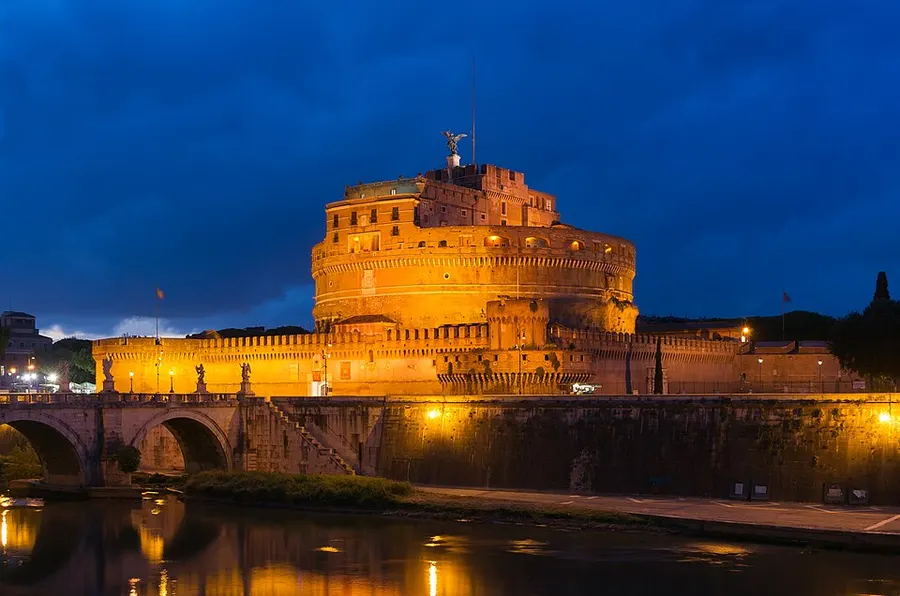
- 🦅 Empire
Empire · Hadrian's Mausoleum
It began as the round mausoleum Hadrian built for himself and later emperors.
Around 139 AD, the same emperor Hadrian who rebuilt the Pantheon raised a huge round mausoleum for himself by the Tiber. For nearly a century after, the ashes of Roman emperors — including the philosopher-emperor Marcus Aurelius — were laid here. In its first form it was a monument to the rulers of the empire.
🔗 Connects toSources:Ancient Roman tomb inscriptions and historical sources
- ✝️ Faith
↑ Because of the last layer:Precisely because it was a tall, solid imperial tomb, it was fit to become the height where an angel appeared, overlooking the whole city.
Faith · An Angel Sheathes His Sword
In the plague of 590, a pope "saw" the Archangel Michael sheathe his sword atop it, a sign the plague would end — and the castle got its name.
In the Roman plague of 590, legend says Pope Gregory the Great led a procession of prayer and beheld the Archangel Michael standing atop the mausoleum, sheathing his sword — a sign the plague would end. From then the pagan emperor’s tomb was called the "Castle of the Holy Angel," a sword-bearing angel raised on its summit. An imperial tomb was rewritten, by a plague and a vision, into a Christian holy place.
Sources:Jacobus de Voragine, The Golden Legend
- 📍 Today
↑ Because of the last layer:Precisely because it was held holy and stood high over the river, the popes chose it as their refuge in the direst hour.
Today · The Pope’s Secret Passage and Refuge
An elevated secret passage runs straight to the Vatican; a pope escaped along it in the Sack of Rome, 1527.
From the Middle Ages the popes turned the castle into a fortress and last refuge, even building an elevated passage, the Passetto, straight to the Vatican. When Imperial troops sacked Rome in 1527, Pope Clement VII escaped along this passage into the castle to save his life. Later it served as a prison. Today it is a museum — one building that over two thousand years has been tomb, holy site, fortress, and prison, and is now the hall that tells all of it.
Sources:Historical sources on the Sack of Rome (1527) · Museo Nazionale di Castel Sant'Angelo
🔭 Meanwhile in the world
In Rome:Hadrian's mausoleum is completed by the Tiber.
At the same time, elsewhere:At the same time, Rome was in the peace of the Five Good Emperors, and the Eastern Han had entered its middle age of court-faction rule.
🧭 Trails through here
Free email course
Rome in 7 Lessons
Before you go, load the stories behind every stone. Seven emails, Colosseum to Sistine — so on the ground you see more than ruins.
That email didn’t look right — try again?
Free · unsubscribe anytime · Privacy