A Century’s Duel of Reason and Passion · Neoclassicism & Romanticism
NeoclassicismLinePortraitureThe Body
Who they are
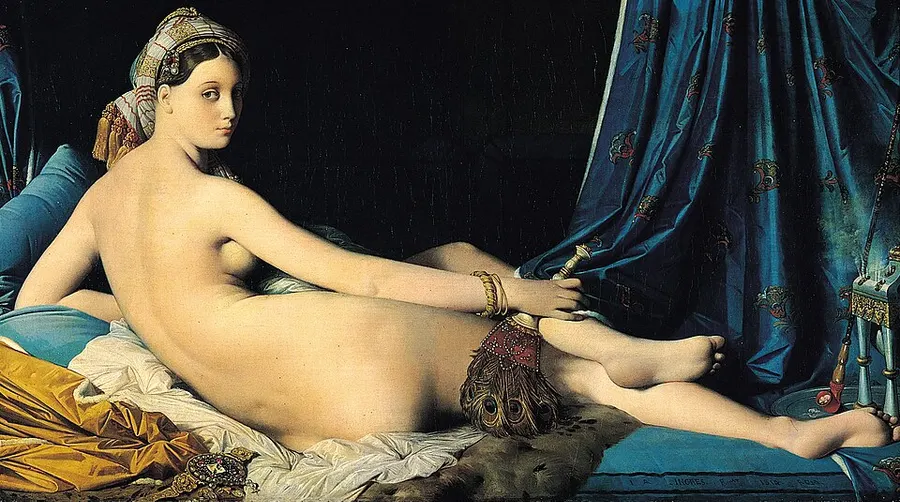
David’s pupil and the emblem of late Neoclassicism, who defended all his life the creed of "the primacy of line," set head-on against the Romantics who prized color and passion. He painted the body smooth and perfect as marble, even lengthening proportions for the sake of elegance — the back of La Grande Odalisque, said to carry a few extra vertebrae, is his famous instance of "distorting" truth for beauty. His portraits are precise and noble, the summit of academic skill.
Primary sourcesLa Grande OdalisqueThe Sourcemany portraits
Key stories
A Few Extra Vertebrae for Beauty
La Grande Odalisque · Ingres, 1814, the Louvre
The back of Ingres’s Grande Odalisque is anatomically impossible: critics counted what looked like two or three extra vertebrae. But Ingres wanted not anatomical correctness but the flowing beauty of the line. He would rather "get the body wrong" than sacrifice that perfect curve — for him, beauty stood above truth.
Below are how modern works borrow or reinterpret this name or story — not the original material. The two differ, so keep them apart.
"Distortion for beauty"The extra vertebrae of the Grande Odalisque became a classic case for the debate of 'ideal beauty vs. anatomical truth'; his 'line vs. color' quarrel with Delacroix is a main thread of 19th-century art.